
Gearboxes
Kiln drive gearboxes
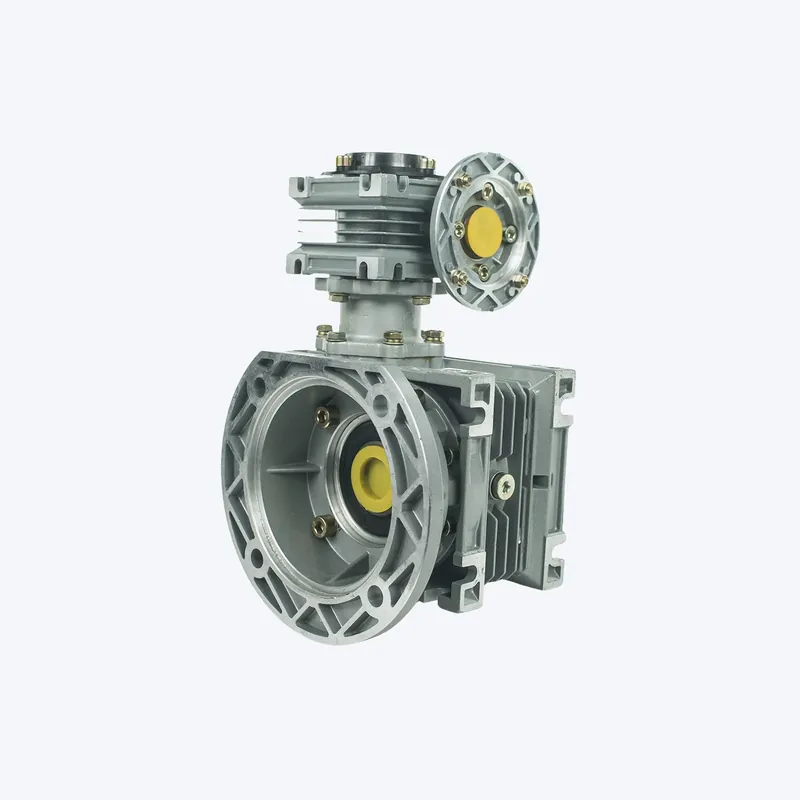
A kiln drive gearbox is a slow-speed, high-ratio unit for furnace drives: industrial and tunnel kilns, heating chambers and rotary kilns. Ratios are 1/200 and 1/450, and on the 1:200 unit the output turns at 1.15 rpm, slow enough to control a loaded, high-inertia mechanism inside a hot chamber. These are specialist gearboxes for high temperature, heavy loads and continuous running.
The drive is a worm arrangement: a 25 mm worm shaft working with a worm wheel, which is how the unit makes high torque at a very low output speed. The input is a B14 flange for small motors of 0.09 to 0.18 kW. Mechanical overload protection is standard, a 5 x 50 steel shear pin together with a key, which give way before the gearing does if the mechanism jams. Mounting bolt centres are 92 x 92 mm.
Sizing starts with the output speed and the torque needed to move the load inside the kiln. The 1:200 ratio and 1.15 rpm suit most tunnel and chamber kilns, but some duties need a stronger or a slower unit. Then check the motor power and its B14 flange mounting, the static and dynamic loads, whether the duty is continuous, cyclic or shock loaded, and the fixing centres and output shaft diameter against the kiln structure.
High temperature decides the last details: lubrication has to be kept under control and the seals have to be able to live at working temperature. Kiln drives are not only a steelworks item; they are used in cement, ceramics, lime, gypsum and chemical plants, anywhere there is a rotary or tunnel kiln. Retrofit versions can be matched dimensionally to an existing installation, so an older kiln can be re-driven without rebuilding it. Send us the duty and we quote within one working day.
Main features
Ratios of 1/200 and 1/450 for very slow output
Output speed of 1.15 rpm at 1:200
25 mm worm shaft working with a worm wheel
B14 input flange for 0.09 to 0.18 kW motors
5 x 50 steel shear pin and key for overload
Mounting bolt centres of 92 x 92 mm
Questions we get asked
How slowly does a kiln drive gearbox turn?
The standard 1:200 unit gives an output speed of 1.15 rpm, which is the range most tunnel and chamber kilns need to move a loaded mechanism under control. A 1/450 ratio is also available where the duty calls for something slower. Tell us the speed and torque at the kiln and we will confirm which ratio fits.
Which motor fits a kiln drive gearbox?
The input is a B14 flange sized for small motors of 0.09 to 0.18 kW, so the motor bolts straight to the gearbox. Kiln drives also work with hydraulic drives and with geared motors. Where the ambient temperature is high, water-cooled motors or motors with compensating arrangements can be used instead of a standard machine.
What protects the drive if the kiln mechanism jams?
A mechanical shear device. The standard build includes a 5 x 50 steel shear pin and a key, which fail first and protect the gearing when the drive is overloaded or the movement locks up. It is a cheap part to replace compared with the gear set, which is the whole point of fitting it.
Are kiln drive gearboxes only for steelworks?
No. They are common in metallurgy and cement, but they are used just as much in ceramics, lime and gypsum production and in the chemical industry, anywhere there is a rotary or tunnel kiln. The requirement is the same everywhere: a very low output speed, constant torque and reliable running in high temperature.
Can one replace the gearbox on an older kiln?
Often, yes. Retrofit versions can be matched dimensionally and by mounting to an existing installation, so the kiln does not have to be rebuilt around the new drive. Check the 92 x 92 mm bolt centres and the output shaft diameter against what you have, and send us photographs or drawings with the enquiry.
Other gearboxes
Request a quotation
Quote for kiln drive gearboxes
Reply within one working day with a price, a lead time and the datasheet.
What lets us quote first time
- Kiln or drum weight and diameter
- Required speed
- Motor power
- Mounting